| ⇦ | 
| ⇨ |
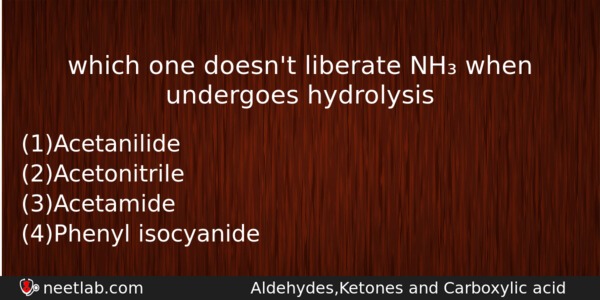
which one doesn’t liberate NH₃ when undergoes hydrolysis
Options
(a) Acetanilide
(b) Acetonitrile
(c) Acetamide
(d) Phenyl isocyanide
Correct Answer:
Phenyl isocyanide
Explanation:
No explanation available. Be the first to write the explanation for this question by commenting below.
Related Questions: - Which of the following sets of quantum numbers violates the rules of quantum mechanics
- When the temperature of reactions will increases then the effect on pH value will
- Amongest the following,the compound that can most readily get sulphonated is
- Action of nitrous acid on ethyl amine gives
- For two ionic solids CaO and KI,identify the wrong statements among the following
Topics: Aldehydes Ketones and Carboxylic Acid
(89)
Subject: Chemistry
(2512)
Important MCQs Based on Medical Entrance Examinations To Improve Your NEET Score
- Which of the following sets of quantum numbers violates the rules of quantum mechanics
- When the temperature of reactions will increases then the effect on pH value will
- Amongest the following,the compound that can most readily get sulphonated is
- Action of nitrous acid on ethyl amine gives
- For two ionic solids CaO and KI,identify the wrong statements among the following
Topics: Aldehydes Ketones and Carboxylic Acid (89)
Subject: Chemistry (2512)
Important MCQs Based on Medical Entrance Examinations To Improve Your NEET Score
18000+ students are using NEETLab to improve their score. What about you?
Solve Previous Year MCQs, Mock Tests, Topicwise Practice Tests, Identify Weak Topics, Formula Flash cards and much more is available in NEETLab Android App to improve your NEET score.

Share this page with your friends
Leave a Reply