| ⇦ | 
| ⇨ |
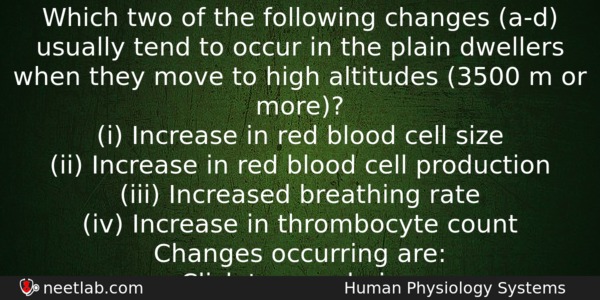
Which two of the following changes (a-d) usually tend to occur in the plain dwellers when they move to high altitudes (3500 m or more)?
(i) Increase in red blood cell size
(ii) Increase in red blood cell production
(iii) Increased breathing rate
(iv) Increase in thrombocyte count
Changes occurring are:
Options
(a) (ii) and (iii)
(b) (iii) and (iv)
(c) (i) and (iv)
(d) (i) and (ii)
Correct Answer:
(ii) and (iii)
Explanation:
At high altitude, the body undergoes numerous changes in order to increase oxygen delivery to cells and improve the efficiency of oxygen usage. The early changes include increased breathing rate and increased red blood cell production.
Related Questions: - Which one of the following is a correct statement about reproduction
- Species that occur in different geographical regions or separated by spatial
- Plasmids are vectors for gene cloning because they
- The ‘end organs of Ruffini’ are receptors of
- Industrial production of ethanol from starch is brought about by
Topics: Human Physiology Systems
(35)
Subject: Biology
(4253)
Important MCQs Based on Medical Entrance Examinations To Improve Your NEET Score
- Which one of the following is a correct statement about reproduction
- Species that occur in different geographical regions or separated by spatial
- Plasmids are vectors for gene cloning because they
- The ‘end organs of Ruffini’ are receptors of
- Industrial production of ethanol from starch is brought about by
Topics: Human Physiology Systems (35)
Subject: Biology (4253)
Important MCQs Based on Medical Entrance Examinations To Improve Your NEET Score
18000+ students are using NEETLab to improve their score. What about you?
Solve Previous Year MCQs, Mock Tests, Topicwise Practice Tests, Identify Weak Topics, Formula Flash cards and much more is available in NEETLab Android App to improve your NEET score.

Share this page with your friends
Leave a Reply