| ⇦ | 
| ⇨ |
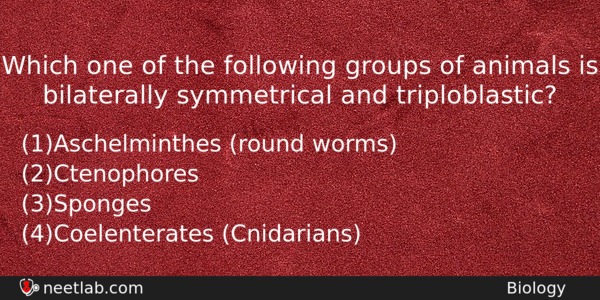
Which one of the following groups of animals is bilaterally symmetrical and triploblastic?
Options
(a) Aschelminthes (round worms)
(b) Ctenophores
(c) Sponges
(d) Coelenterates (Cnidarians)
Correct Answer:
Aschelminthes (round worms)
Explanation:
Aschelminthes is bilaterally symmetrical and triploblastic. These are mostly aquatic, free living or parasitic. Their body is three layered which is ectoderm, mesoderm and endoderm.
Related Questions: - Which one of the following is the most widely accepted method of contraception
- The pigment responsible for photomorphogenetic response is
- Bulk of carbon dioxide (CO₂) released form body tissues into the blood is present as
- Nucellar polyembryony is reported in species of
- End products of areobic respiration are
Question Type: Memory
(964)
Difficulty Level: Easy
(1008)
Topics: Plant and Animal Kingdom
(295)
Subject: Biology
(4253)
Important MCQs Based on Medical Entrance Examinations To Improve Your NEET Score
- Which one of the following is the most widely accepted method of contraception
- The pigment responsible for photomorphogenetic response is
- Bulk of carbon dioxide (CO₂) released form body tissues into the blood is present as
- Nucellar polyembryony is reported in species of
- End products of areobic respiration are
Question Type: Memory (964)
Difficulty Level: Easy (1008)
Topics: Plant and Animal Kingdom (295)
Subject: Biology (4253)
Important MCQs Based on Medical Entrance Examinations To Improve Your NEET Score
18000+ students are using NEETLab to improve their score. What about you?
Solve Previous Year MCQs, Mock Tests, Topicwise Practice Tests, Identify Weak Topics, Formula Flash cards and much more is available in NEETLab Android App to improve your NEET score.

Share this page with your friends
Leave a Reply