| ⇦ | 
| ⇨ |
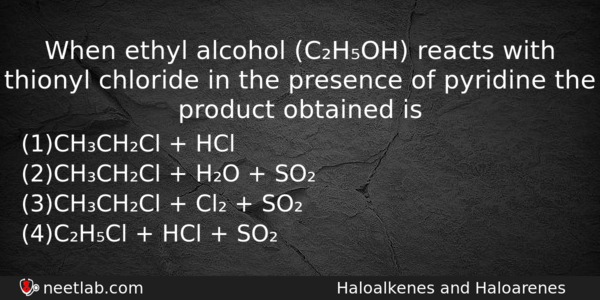
When ethyl alcohol (C₂H₅OH) reacts with thionyl chloride in the presence of pyridine the product obtained is
Options
(a) CH₃CH₂Cl + HCl
(b) CH₃CH₂Cl + H₂O + SO₂
(c) CH₃CH₂Cl + Cl₂ + SO₂
(d) C₂H₅Cl + HCl + SO₂
Correct Answer:
C₂H₅Cl + HCl + SO₂
Explanation:
C₂H₅OH + SOCl₂ → C₂H₅Cl + HCl + SO₂.
Related Questions: - Magnetic moment 2.83 BM is given by which of the following ions
- The greenhouse effect can be caused by the presence of the
- The normality of solution containing 31.5g of hydrated oxalic acid (H₂C₂O₄.2H₂O)
- The boiling point of 0.2 mol kg⁻¹ solution of X in water is greater than equimolal
- Impurities present in the ore react to form a fusible substance known as
Topics: Haloalkenes and Haloarenes
(78)
Subject: Chemistry
(2512)
Important MCQs Based on Medical Entrance Examinations To Improve Your NEET Score
- Magnetic moment 2.83 BM is given by which of the following ions
- The greenhouse effect can be caused by the presence of the
- The normality of solution containing 31.5g of hydrated oxalic acid (H₂C₂O₄.2H₂O)
- The boiling point of 0.2 mol kg⁻¹ solution of X in water is greater than equimolal
- Impurities present in the ore react to form a fusible substance known as
Topics: Haloalkenes and Haloarenes (78)
Subject: Chemistry (2512)
Important MCQs Based on Medical Entrance Examinations To Improve Your NEET Score
18000+ students are using NEETLab to improve their score. What about you?
Solve Previous Year MCQs, Mock Tests, Topicwise Practice Tests, Identify Weak Topics, Formula Flash cards and much more is available in NEETLab Android App to improve your NEET score.

Share this page with your friends
Leave a Reply