| ⇦ | 
| ⇨ |
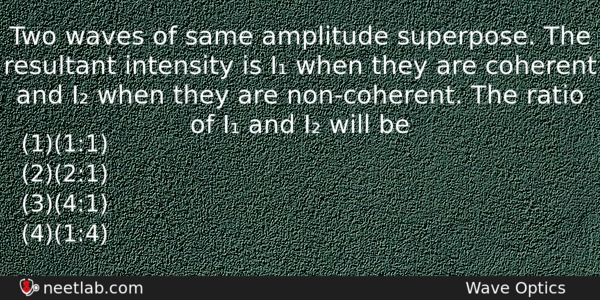
Two waves of same amplitude superpose. The resultant intensity is I₁ when they are coherent and I₂ when they are non-coherent. The ratio of I₁ and I₂ will be
Options
(a) (1:1)
(b) (2:1)
(c) (4:1)
(d) (1:4)
Correct Answer:
(2:1)
Explanation:
I₁ = 4I and I₂ = 2I
Therefore, I₁ / I₂ = 4I / 2I = 2 / 1
Related Questions: - Two circuits have a mutual inductance of 0.1 H. What average e.m.f. is induced
- A remote-sensing satellite of earth revolves in a circular orbit at a height
- The depth at which the effective value of acceleration due to gravity is g/4
- A transformer is used to light a 100 W and 110 V lamp from a 220 V mains.
- If A=4i+4j+4k and b=3i+j+4k, then angle between vectors A and B is
Topics: Wave Optics
(101)
Subject: Physics
(2479)
Important MCQs Based on Medical Entrance Examinations To Improve Your NEET Score
- Two circuits have a mutual inductance of 0.1 H. What average e.m.f. is induced
- A remote-sensing satellite of earth revolves in a circular orbit at a height
- The depth at which the effective value of acceleration due to gravity is g/4
- A transformer is used to light a 100 W and 110 V lamp from a 220 V mains.
- If A=4i+4j+4k and b=3i+j+4k, then angle between vectors A and B is
Topics: Wave Optics (101)
Subject: Physics (2479)
Important MCQs Based on Medical Entrance Examinations To Improve Your NEET Score
18000+ students are using NEETLab to improve their score. What about you?
Solve Previous Year MCQs, Mock Tests, Topicwise Practice Tests, Identify Weak Topics, Formula Flash cards and much more is available in NEETLab Android App to improve your NEET score.

Share this page with your friends
Leave a Reply