| ⇦ | 
| ⇨ |
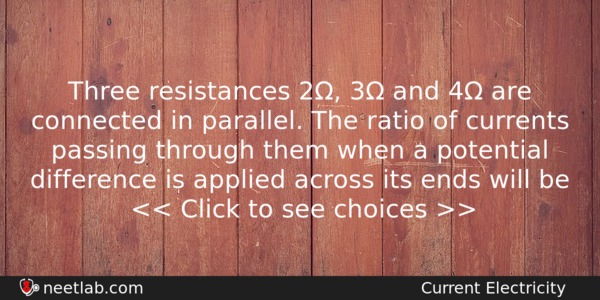
Three resistances 2Ω, 3Ω and 4Ω are connected in parallel. The ratio of currents passing through them when a potential difference is applied across its ends will be
Options
(a) (5:4:3)
(b) (6:3:2)
(c) (4:3:2)
(d) (6:4:3)
Correct Answer:
(6:4:3)
Explanation:
No explanation available. Be the first to write the explanation for this question by commenting below.
Related Questions: - Initial angular velocity of a circular disc of mass M is ?¬ツチ.Then, two small spheres
- Van der waals,equation of state is(p+a/v²)(V-b)=nRT. The dimensions of a and b
- If vectors A=cos wti + sin wtj and B= cos wt/2 i + sin wt/2 j are functions of time,
- A stone tied to the end of a string of 1 m long is whirled in a horizontal circle
- Two stones of masses m and 2m are whirled in horizontal circles, the heavier one
Topics: Current Electricity
(136)
Subject: Physics
(2479)
Important MCQs Based on Medical Entrance Examinations To Improve Your NEET Score
- Initial angular velocity of a circular disc of mass M is ?¬ツチ.Then, two small spheres
- Van der waals,equation of state is(p+a/v²)(V-b)=nRT. The dimensions of a and b
- If vectors A=cos wti + sin wtj and B= cos wt/2 i + sin wt/2 j are functions of time,
- A stone tied to the end of a string of 1 m long is whirled in a horizontal circle
- Two stones of masses m and 2m are whirled in horizontal circles, the heavier one
Topics: Current Electricity (136)
Subject: Physics (2479)
Important MCQs Based on Medical Entrance Examinations To Improve Your NEET Score
18000+ students are using NEETLab to improve their score. What about you?
Solve Previous Year MCQs, Mock Tests, Topicwise Practice Tests, Identify Weak Topics, Formula Flash cards and much more is available in NEETLab Android App to improve your NEET score.

Share this page with your friends
Leave a Reply