| ⇦ | 
| ⇨ |
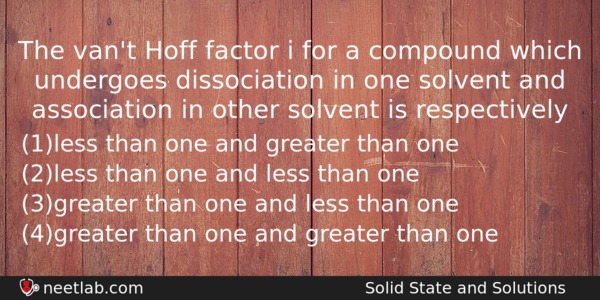
The van’t Hoff factor i for a compound which undergoes dissociation in one solvent and association in other solvent is respectively
Options
(a) less than one and greater than one
(b) less than one and less than one
(c) greater than one and less than one
(d) greater than one and greater than one
Correct Answer:
greater than one and less than one
Explanation:
No explanation available. Be the first to write the explanation for this question by commenting below.
Related Questions: - Which of the following is ferroelectric compound
- The heat of neutralization is the highest in the following case
- Which is not the property transition elements
- Increasing order of rms velocities of H₂,O₂,N₂ and HBr is
- D(+)-glucose reacts with hydroxyl amine and yields an oxime.
Topics: Solid State and Solutions
(91)
Subject: Chemistry
(2512)
Important MCQs Based on Medical Entrance Examinations To Improve Your NEET Score
- Which of the following is ferroelectric compound
- The heat of neutralization is the highest in the following case
- Which is not the property transition elements
- Increasing order of rms velocities of H₂,O₂,N₂ and HBr is
- D(+)-glucose reacts with hydroxyl amine and yields an oxime.
Topics: Solid State and Solutions (91)
Subject: Chemistry (2512)
Important MCQs Based on Medical Entrance Examinations To Improve Your NEET Score
18000+ students are using NEETLab to improve their score. What about you?
Solve Previous Year MCQs, Mock Tests, Topicwise Practice Tests, Identify Weak Topics, Formula Flash cards and much more is available in NEETLab Android App to improve your NEET score.

Share this page with your friends
Leave a Reply