| ⇦ | 
| ⇨ |
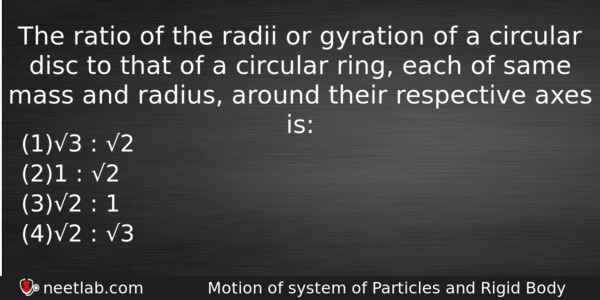
The ratio of the radii or gyration of a circular disc to that of a circular ring, each of same mass and radius, around their respective axes is:
Options
(a) √3 : √2
(b) 1 : √2
(c) √2 : 1
(d) √2 : √3
Correct Answer:
1 : √2
Explanation:
The radius of gyration of a ociruclar ring K’ = R (Since both have the same mass and radius)
K / K’ = R / (√2 / R) = 1 / √2
Related Questions: - Cathode rays are produced when the pressure is of the order of
- A particle moves along a circle of radius 20/π m with constant tangential acceleration
- A student measures the terminal potential difference (V) of a cell
- A current of 5 A is flowing at 220 V in the primary coil of a transformer. If the voltage
- A bar magnet of magnetic moment M is placed at right angles to a magnetic
Topics: Motion of system of Particles and Rigid Body
(73)
Subject: Physics
(2479)
Important MCQs Based on Medical Entrance Examinations To Improve Your NEET Score
- Cathode rays are produced when the pressure is of the order of
- A particle moves along a circle of radius 20/π m with constant tangential acceleration
- A student measures the terminal potential difference (V) of a cell
- A current of 5 A is flowing at 220 V in the primary coil of a transformer. If the voltage
- A bar magnet of magnetic moment M is placed at right angles to a magnetic
Topics: Motion of system of Particles and Rigid Body (73)
Subject: Physics (2479)
Important MCQs Based on Medical Entrance Examinations To Improve Your NEET Score
18000+ students are using NEETLab to improve their score. What about you?
Solve Previous Year MCQs, Mock Tests, Topicwise Practice Tests, Identify Weak Topics, Formula Flash cards and much more is available in NEETLab Android App to improve your NEET score.

Share this page with your friends
Leave a Reply