| ⇦ | 
| ⇨ |
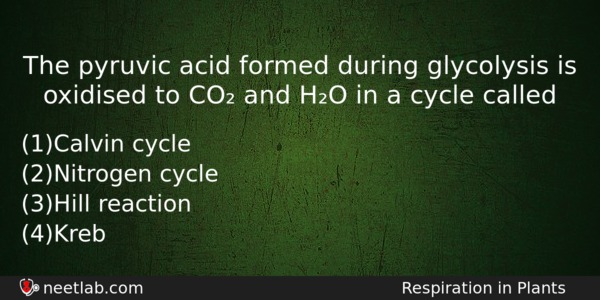
The pyruvic acid formed during glycolysis is oxidised to CO₂ and H₂O in a cycle called
Options
(a) Calvin cycle
(b) Nitrogen cycle
(c) Hill reaction
(d) Kreb’s cycle
Correct Answer:
Kreb’s cycle
Explanation:
No explanation available. Be the first to write the explanation for this question by commenting below.
Related Questions: - Which one of the following pairs is wrongly matched? Alcohol – nitrogenase
- An organelle present in plant cells but absent from those of animals is
- The reaction of glycolysis occur in
- Number of prothallial cells present in an anther is
- Collagen fibres of connective tissue are
Topics: Respiration in Plants
(184)
Subject: Biology
(4253)
Important MCQs Based on Medical Entrance Examinations To Improve Your NEET Score
- Which one of the following pairs is wrongly matched? Alcohol – nitrogenase
- An organelle present in plant cells but absent from those of animals is
- The reaction of glycolysis occur in
- Number of prothallial cells present in an anther is
- Collagen fibres of connective tissue are
Topics: Respiration in Plants (184)
Subject: Biology (4253)
Important MCQs Based on Medical Entrance Examinations To Improve Your NEET Score
18000+ students are using NEETLab to improve their score. What about you?
Solve Previous Year MCQs, Mock Tests, Topicwise Practice Tests, Identify Weak Topics, Formula Flash cards and much more is available in NEETLab Android App to improve your NEET score.

Share this page with your friends
Leave a Reply