| ⇦ | 
| ⇨ |
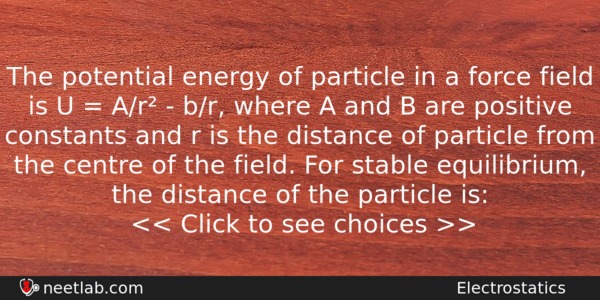
The potential energy of particle in a force field is U = A/r² – b/r, where A and B are positive constants and r is the distance of particle from the centre of the field. For stable equilibrium, the distance of the particle is:
Options
(a) B / 2A
(b) 2A / B
(c) A / B
(d) B / A
Correct Answer:
2A / B
Explanation:
for equilibrium dU/ dr = 0
-2A/r³ + B/r² = 0 r = 2A / B
for stable equilibrium d²U /dr² should be positive for the value of r.
here d²U / dr² = 6A/r⁴ – 2B/r³ is +ve value for r = 2A / B So.
Related Questions: - A beam of light of λ=600 nm from a distant source falls on a single slit 1 mm wide
- At what angle should the two forces 2P and √2 P act,so that the resultant force is P√10?
- A particle is moving in a circle with uniform speed v. In moving from a point to another
- Acceleration of a particle, executing SHM, at its mean position is
- If a charge on the body is 1nC, then how many electrons are present on the body?
Topics: Electrostatics
(146)
Subject: Physics
(2479)
Important MCQs Based on Medical Entrance Examinations To Improve Your NEET Score
- A beam of light of λ=600 nm from a distant source falls on a single slit 1 mm wide
- At what angle should the two forces 2P and √2 P act,so that the resultant force is P√10?
- A particle is moving in a circle with uniform speed v. In moving from a point to another
- Acceleration of a particle, executing SHM, at its mean position is
- If a charge on the body is 1nC, then how many electrons are present on the body?
Topics: Electrostatics (146)
Subject: Physics (2479)
Important MCQs Based on Medical Entrance Examinations To Improve Your NEET Score
18000+ students are using NEETLab to improve their score. What about you?
Solve Previous Year MCQs, Mock Tests, Topicwise Practice Tests, Identify Weak Topics, Formula Flash cards and much more is available in NEETLab Android App to improve your NEET score.

Share this page with your friends
Leave a Reply