| ⇦ | 
| ⇨ |
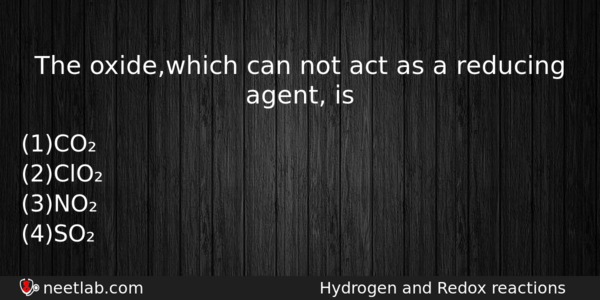
The oxide,which can not act as a reducing agent, is
Options
(a) CO₂
(b) ClO₂
(c) NO₂
(d) SO₂
Correct Answer:
CO₂
Explanation:
No explanation available. Be the first to write the explanation for this question by commenting below.
Related Questions: - In which of the following molecules is hydrogen bridge bond present
- Which of the following on addition of water in presence of acid gives a ketone
- Which kind of isomerism is exhibited by octahedral [Co(NH₃)₄Br₂]Cl
- During the electrolysis of H₂O, volume of H₂ and O₂ are released in the ratio
- The most effective electrolyte for the coagulation of As₂S₃ sol is
Topics: Hydrogen and Redox Reactions
(174)
Subject: Chemistry
(2512)
Important MCQs Based on Medical Entrance Examinations To Improve Your NEET Score
- In which of the following molecules is hydrogen bridge bond present
- Which of the following on addition of water in presence of acid gives a ketone
- Which kind of isomerism is exhibited by octahedral [Co(NH₃)₄Br₂]Cl
- During the electrolysis of H₂O, volume of H₂ and O₂ are released in the ratio
- The most effective electrolyte for the coagulation of As₂S₃ sol is
Topics: Hydrogen and Redox Reactions (174)
Subject: Chemistry (2512)
Important MCQs Based on Medical Entrance Examinations To Improve Your NEET Score
18000+ students are using NEETLab to improve their score. What about you?
Solve Previous Year MCQs, Mock Tests, Topicwise Practice Tests, Identify Weak Topics, Formula Flash cards and much more is available in NEETLab Android App to improve your NEET score.

Share this page with your friends
Leave a Reply