| ⇦ | 
| ⇨ |
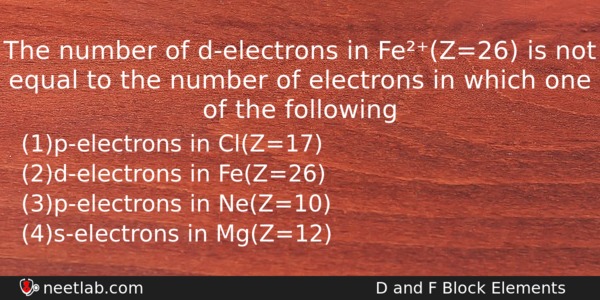
The number of d-electrons in Fe²⁺(Z=26) is not equal to the number of electrons in which one of the following
Options
(a) p-electrons in Cl(Z=17)
(b) d-electrons in Fe(Z=26)
(c) p-electrons in Ne(Z=10)
(d) s-electrons in Mg(Z=12)
Correct Answer:
p-electrons in Cl(Z=17)
Explanation:
Fe⁺²=3d⁶(number of ‘d’ electrons =6)
In Cl = 1s² 2s² 2p⁶ 3s² 3p⁵
total p electrons =11 which are not equal to number of d electrons in Fe⁺²
p-electrons in Ne =1s² 2s² 2p⁶=6
s-electrons in Mg=1s² 2s² 2p⁶ 3s² =6.
Related Questions: - Which of the following hormones contains iodine
- Among K, Ca,Fe and Zn the element which can form more than one binary compound
- Co(NH₃)₅ONOCl₂ and Co(NH₃)₅NO₂Cl₂ show
- Which of the following has zero dipole moment
- The first ionisation potential will be maximum for
Topics: D and F Block Elements
(91)
Subject: Chemistry
(2512)
Important MCQs Based on Medical Entrance Examinations To Improve Your NEET Score
- Which of the following hormones contains iodine
- Among K, Ca,Fe and Zn the element which can form more than one binary compound
- Co(NH₃)₅ONOCl₂ and Co(NH₃)₅NO₂Cl₂ show
- Which of the following has zero dipole moment
- The first ionisation potential will be maximum for
Topics: D and F Block Elements (91)
Subject: Chemistry (2512)
Important MCQs Based on Medical Entrance Examinations To Improve Your NEET Score
18000+ students are using NEETLab to improve their score. What about you?
Solve Previous Year MCQs, Mock Tests, Topicwise Practice Tests, Identify Weak Topics, Formula Flash cards and much more is available in NEETLab Android App to improve your NEET score.

Share this page with your friends
Leave a Reply