| ⇦ | 
| ⇨ |
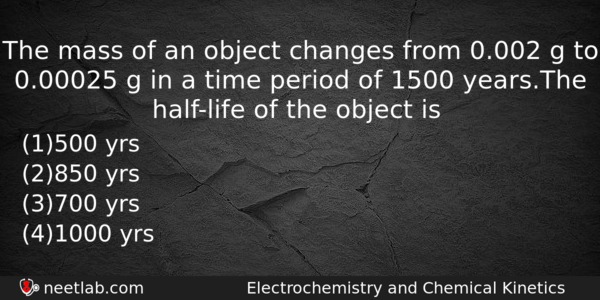
The mass of an object changes from 0.002 g to 0.00025 g in a time period of 1500 years.The half-life of the object is
Options
(a) 500 yrs
(b) 850 yrs
(c) 700 yrs
(d) 1000 yrs
Correct Answer:
500 yrs
Explanation:
Here, N₀ = 0.002 g, N = 0.00025 g. t = 1500 years.
Now , k = 2.303 / t log N₀ / N = 2.303 / 1500 log (0.002 / 0.00025).
t (1/2) = 0.6993 / k = 500 years.
Related Questions: - Terylene is used for making
- Which property of colloidal solution is not dependent on the charge on colloidal
- Schiff’s reagent is
- Phenol reacts with bromine in chloroform at low temperature to gives
- An emulsion is a colloidal dispersion of
Topics: Electrochemistry and Chemical Kinetics
(87)
Subject: Chemistry
(2512)
Important MCQs Based on Medical Entrance Examinations To Improve Your NEET Score
- Terylene is used for making
- Which property of colloidal solution is not dependent on the charge on colloidal
- Schiff’s reagent is
- Phenol reacts with bromine in chloroform at low temperature to gives
- An emulsion is a colloidal dispersion of
Topics: Electrochemistry and Chemical Kinetics (87)
Subject: Chemistry (2512)
Important MCQs Based on Medical Entrance Examinations To Improve Your NEET Score
18000+ students are using NEETLab to improve their score. What about you?
Solve Previous Year MCQs, Mock Tests, Topicwise Practice Tests, Identify Weak Topics, Formula Flash cards and much more is available in NEETLab Android App to improve your NEET score.

Share this page with your friends
Leave a Reply