| ⇦ | 
| ⇨ |
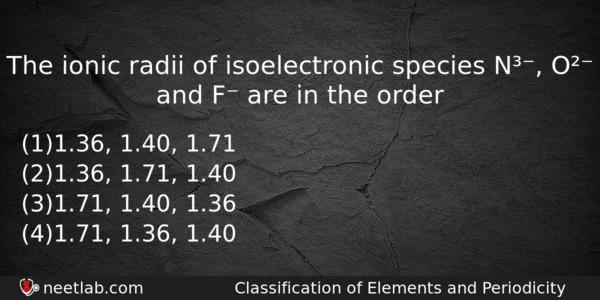
The ionic radii of isoelectronic species N³⁻, O²⁻ and F⁻ are in the order
Options
(a) 1.36, 1.40, 1.71
(b) 1.36, 1.71, 1.40
(c) 1.71, 1.40, 1.36
(d) 1.71, 1.36, 1.40
Correct Answer:
1.71, 1.40, 1.36
Explanation:
No explanation available. Be the first to write the explanation for this question by commenting below.
Related Questions: - Which of the following compounds has the highest boiling point
- If 0.2 gram of an organic compound containing carbon, hydrogen and oxygen
- Caprolactum is the monomer of
- Hydrolysis of an ester in an alkaline medium is
- Complex ion is shown by
Topics: Classification of Elements and Periodicity
(94)
Subject: Chemistry
(2512)
Important MCQs Based on Medical Entrance Examinations To Improve Your NEET Score
- Which of the following compounds has the highest boiling point
- If 0.2 gram of an organic compound containing carbon, hydrogen and oxygen
- Caprolactum is the monomer of
- Hydrolysis of an ester in an alkaline medium is
- Complex ion is shown by
Topics: Classification of Elements and Periodicity (94)
Subject: Chemistry (2512)
Important MCQs Based on Medical Entrance Examinations To Improve Your NEET Score
18000+ students are using NEETLab to improve their score. What about you?
Solve Previous Year MCQs, Mock Tests, Topicwise Practice Tests, Identify Weak Topics, Formula Flash cards and much more is available in NEETLab Android App to improve your NEET score.

Share this page with your friends
Leave a Reply