| ⇦ | 
| ⇨ |
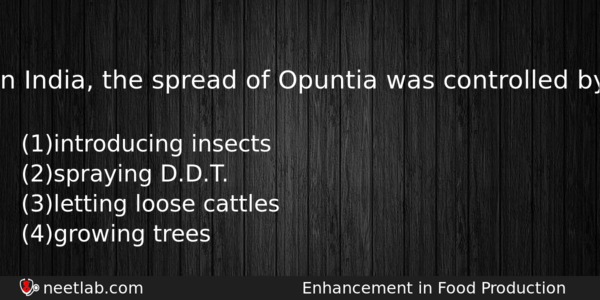
In India, the spread of Opuntia was controlled by
Options
(a) introducing insects
(b) spraying D.D.T.
(c) letting loose cattles
(d) growing trees
Correct Answer:
introducing insects
Explanation:
The control of pests by biological (rather than chemical) means is achieved by breeding disease-resistant crops or by introducing a natural enemy of the pest, such as a parasite or predator, e.g. control of the prickly pear cactus (Opuntia) was done by introducing the cactus moth (Cactoblastis, Cactorum) whose caterpillars feed on the growing shoots of the plants.
Related Questions: - Cork cambium and vascular cambium are the examples of
- Which of the following about organism is not correct?
- Bowman’s glands are located in the
- Leaves become modified into spines in
- Which group of gases cause green house effect?
Topics: Enhancement in Food Production
(101)
Subject: Biology
(4253)
Important MCQs Based on Medical Entrance Examinations To Improve Your NEET Score
- Cork cambium and vascular cambium are the examples of
- Which of the following about organism is not correct?
- Bowman’s glands are located in the
- Leaves become modified into spines in
- Which group of gases cause green house effect?
Topics: Enhancement in Food Production (101)
Subject: Biology (4253)
Important MCQs Based on Medical Entrance Examinations To Improve Your NEET Score
18000+ students are using NEETLab to improve their score. What about you?
Solve Previous Year MCQs, Mock Tests, Topicwise Practice Tests, Identify Weak Topics, Formula Flash cards and much more is available in NEETLab Android App to improve your NEET score.

Share this page with your friends
Leave a Reply