| ⇦ | 
| ⇨ |
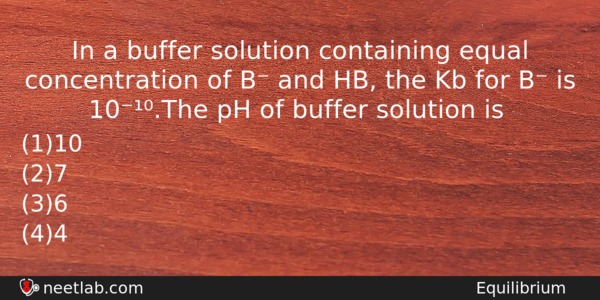
In a buffer solution containing equal concentration of B⁻ and HB, the Kb for B⁻ is 10⁻¹⁰.The pH of buffer solution is
Options
(a) 10
(b) 7
(c) 6
(d) 4
Correct Answer:
4
Explanation:
We know, pOH = pK(b) + log{[B⁻]/[HB]},
Since, [B⁻] = [HB] (given).
Therefore pOH = pK(b) ⇒ pOH = 10,
Therefore pH = 14 – 10 = 4.
Related Questions: - Which of the following orders of ionic radii is correctly represented
- 2-Acetoxy benzoic acid is used as an
- Which one will give positive iodoform test
- The maximum number of hydrogen bonds formed by a water molecule in ice is
- The oxidation state of sulpur in sodium tetrathionate (Na₂S₄O₆) is
Topics: Equilibrium
(104)
Subject: Chemistry
(2512)
Important MCQs Based on Medical Entrance Examinations To Improve Your NEET Score
- Which of the following orders of ionic radii is correctly represented
- 2-Acetoxy benzoic acid is used as an
- Which one will give positive iodoform test
- The maximum number of hydrogen bonds formed by a water molecule in ice is
- The oxidation state of sulpur in sodium tetrathionate (Na₂S₄O₆) is
Topics: Equilibrium (104)
Subject: Chemistry (2512)
Important MCQs Based on Medical Entrance Examinations To Improve Your NEET Score
18000+ students are using NEETLab to improve their score. What about you?
Solve Previous Year MCQs, Mock Tests, Topicwise Practice Tests, Identify Weak Topics, Formula Flash cards and much more is available in NEETLab Android App to improve your NEET score.

Share this page with your friends
Leave a Reply