| ⇦ | 
| ⇨ |
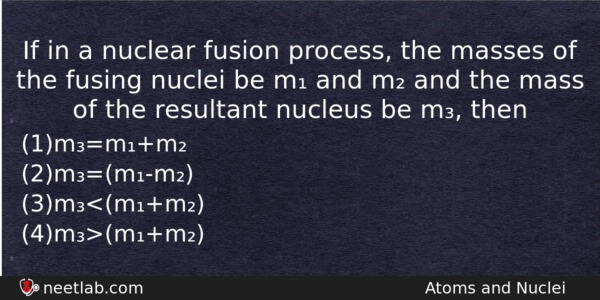
If in a nuclear fusion process, the masses of the fusing nuclei be m₁ and m₂ and the mass of the resultant nucleus be m₃, then
Options
(a) m₃=m₁+m₂
(b) m₃=(m₁-m₂)
(c) m₃<(m₁+m₂)
(d) m₃>(m₁+m₂)
Correct Answer:
m₃<(m₁+m₂)
Explanation:
(m₁+m₂) = m₃ + binding energy equivalent to mass
⇒ (m₁+m₂) > m₃
⇒ m₃<(m₁+m₂)
Related Questions: - Two identical long conducting wires AOB and COD are placed at right angle
- The electromagnetic theory of light failed to explain
- A photocell employs photoelectric effect to convert
- A solid sphere is rotating in free space.If the radius of the sphere is increased
- Two coherent sources of different intensities send waves which interfere.
Topics: Atoms and Nuclei
(136)
Subject: Physics
(2479)
Important MCQs Based on Medical Entrance Examinations To Improve Your NEET Score
- Two identical long conducting wires AOB and COD are placed at right angle
- The electromagnetic theory of light failed to explain
- A photocell employs photoelectric effect to convert
- A solid sphere is rotating in free space.If the radius of the sphere is increased
- Two coherent sources of different intensities send waves which interfere.
Topics: Atoms and Nuclei (136)
Subject: Physics (2479)
Important MCQs Based on Medical Entrance Examinations To Improve Your NEET Score
18000+ students are using NEETLab to improve their score. What about you?
Solve Previous Year MCQs, Mock Tests, Topicwise Practice Tests, Identify Weak Topics, Formula Flash cards and much more is available in NEETLab Android App to improve your NEET score.

Share this page with your friends
Leave a Reply