| ⇦ | 
| ⇨ |
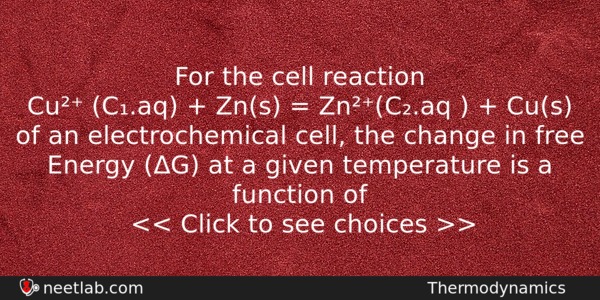
For the cell reaction
Cu²⁺ (C₁.aq) + Zn(s) = Zn²⁺(C₂.aq ) + Cu(s)
of an electrochemical cell, the change in free Energy (ΔG) at a given temperature is a function of
Options
(a) ln (C₂)
(b) ln (C₂/C₁)
(c) ln (C₁)
(d) ln (C₁ + C₂)
Correct Answer:
ln (C₂/C₁)
Explanation:
No explanation available. Be the first to write the explanation for this question by commenting below.
Related Questions: - The coordination number of a metal in coordination compounds is
- Pick out the stronger reducing agent among the following oxyacids of phosphorus
- Glycerol reacts with KHSO₄ to form
- Butanenitrile is prepared by heating
- Which of the following is dihydric alcohol
Topics: Thermodynamics
(179)
Subject: Chemistry
(2512)
Important MCQs Based on Medical Entrance Examinations To Improve Your NEET Score
- The coordination number of a metal in coordination compounds is
- Pick out the stronger reducing agent among the following oxyacids of phosphorus
- Glycerol reacts with KHSO₄ to form
- Butanenitrile is prepared by heating
- Which of the following is dihydric alcohol
Topics: Thermodynamics (179)
Subject: Chemistry (2512)
Important MCQs Based on Medical Entrance Examinations To Improve Your NEET Score
18000+ students are using NEETLab to improve their score. What about you?
Solve Previous Year MCQs, Mock Tests, Topicwise Practice Tests, Identify Weak Topics, Formula Flash cards and much more is available in NEETLab Android App to improve your NEET score.

Share this page with your friends
Leave a Reply