| ⇦ | 
| ⇨ |
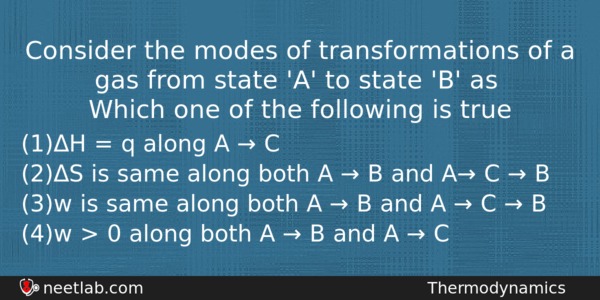
Consider the modes of transformations of a gas from state ‘A’ to state ‘B’ as
Which one of the following is true
Options
(a) ΔH = q along A → C
(b) ΔS is same along both A → B and A→ C → B
(c) w is same along both A → B and A → C → B
(d) w > 0 along both A → B and A → C
Correct Answer:
ΔS is same along both A → B and A→ C → B
Explanation:
Entropy is a state function i.e. the change in entropy depends upon the initial and final states of the system and not on how that change is brought about.
Related Questions: - The calorific value of fats,carbohydrates and proteins is in the order of
- A secondary amine could be prepared readily from the starting material
- Phenolic carboxylic acids may be prepared by
- Glycerine is purified by
- The compounds CHCl₃ and HF lead to the formation of a compound of fluorine
Topics: Thermodynamics
(179)
Subject: Chemistry
(2512)
Important MCQs Based on Medical Entrance Examinations To Improve Your NEET Score
- The calorific value of fats,carbohydrates and proteins is in the order of
- A secondary amine could be prepared readily from the starting material
- Phenolic carboxylic acids may be prepared by
- Glycerine is purified by
- The compounds CHCl₃ and HF lead to the formation of a compound of fluorine
Topics: Thermodynamics (179)
Subject: Chemistry (2512)
Important MCQs Based on Medical Entrance Examinations To Improve Your NEET Score
18000+ students are using NEETLab to improve their score. What about you?
Solve Previous Year MCQs, Mock Tests, Topicwise Practice Tests, Identify Weak Topics, Formula Flash cards and much more is available in NEETLab Android App to improve your NEET score.

Share this page with your friends
Leave a Reply