| ⇦ | 
| ⇨ |
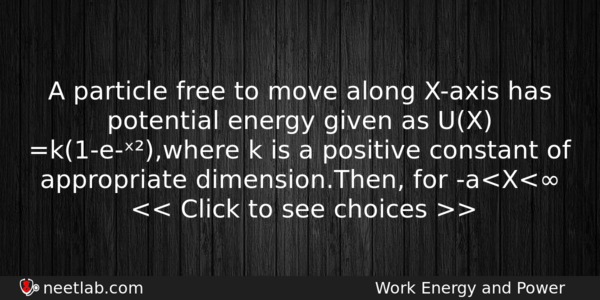
A particle free to move along X-axis has potential energy given as U(X) =k(1-e-ˣ²),where k is a positive constant of appropriate dimension.Then, for -a
Options
(a) at points away from the origin, the particle is in unstable equilibrium
(b) for any finite non-zero value of x,there is a force directed away from the origin
(c) if its total mechanical energy isk/2, it has its minimum kinetic energy at the origin
(d) if its total mechanical energy isk/2, it has its maximum kinetic energy at the origin
Correct Answer:
if its total mechanical energy isk/2, it has its maximum kinetic energy at the origin
Explanation:
No explanation available. Be the first to write the explanation for this question by commenting below.
Related Questions: - A cylindrical capacitors has charge Q and length L. If both the charge and length
- In a thermodynamic system, working substance is ideal gas. Its internal energy
- Two cities are 150 km apart. Electric power is sent from one city to another city
- When a ceiling fan is switched off its angular velocity reduces to 50% while
- The maximum and minimum intensities of two sources is 4:1. The ratio of amplitude is
Topics: Work Energy and Power
(94)
Subject: Physics
(2479)
Important MCQs Based on Medical Entrance Examinations To Improve Your NEET Score
- A cylindrical capacitors has charge Q and length L. If both the charge and length
- In a thermodynamic system, working substance is ideal gas. Its internal energy
- Two cities are 150 km apart. Electric power is sent from one city to another city
- When a ceiling fan is switched off its angular velocity reduces to 50% while
- The maximum and minimum intensities of two sources is 4:1. The ratio of amplitude is
Topics: Work Energy and Power (94)
Subject: Physics (2479)
Important MCQs Based on Medical Entrance Examinations To Improve Your NEET Score
18000+ students are using NEETLab to improve their score. What about you?
Solve Previous Year MCQs, Mock Tests, Topicwise Practice Tests, Identify Weak Topics, Formula Flash cards and much more is available in NEETLab Android App to improve your NEET score.

Share this page with your friends
Leave a Reply