| ⇦ | 
| ⇨ |
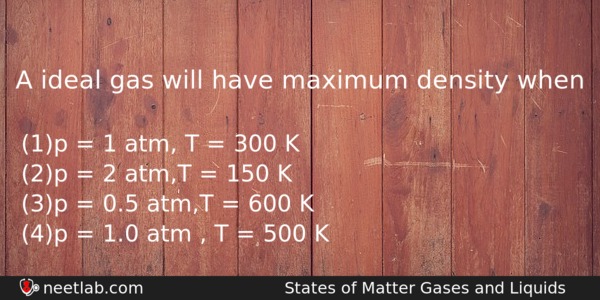
A ideal gas will have maximum density when
Options
(a) p = 1 atm, T = 300 K
(b) p = 2 atm,T = 150 K
(c) p = 0.5 atm,T = 600 K
(d) p = 1.0 atm , T = 500 K
Correct Answer:
p = 2 atm,T = 150 K
Explanation:
An ideal gas will have maximum density at high pressure and low temperature i.e. when P = 2 atm, T = 150 K.
Related Questions: - If uncertainty in position and momentum are equal, then uncertainty in velocity
- A detergent has which of the following group attached to the terminal of a long carbon
- Which of the following equations describe the first law of thermodynamics
- The electronic configuration of gadolinium (Atomic No.64) is
- A molal solution is one that contains one mole of a solute in
Topics: States of Matter Gases and Liquids
(80)
Subject: Chemistry
(2512)
Important MCQs Based on Medical Entrance Examinations To Improve Your NEET Score
- If uncertainty in position and momentum are equal, then uncertainty in velocity
- A detergent has which of the following group attached to the terminal of a long carbon
- Which of the following equations describe the first law of thermodynamics
- The electronic configuration of gadolinium (Atomic No.64) is
- A molal solution is one that contains one mole of a solute in
Topics: States of Matter Gases and Liquids (80)
Subject: Chemistry (2512)
Important MCQs Based on Medical Entrance Examinations To Improve Your NEET Score
18000+ students are using NEETLab to improve their score. What about you?
Solve Previous Year MCQs, Mock Tests, Topicwise Practice Tests, Identify Weak Topics, Formula Flash cards and much more is available in NEETLab Android App to improve your NEET score.

Share this page with your friends
PV=nRT pv=W/m RT. P=W/v RT/m P=dRT/m since W/v= d and d=mp/RT so here at high pressure and low temp ,p=2, and t=150 are suitable in given options