| ⇦ | 
| ⇨ |
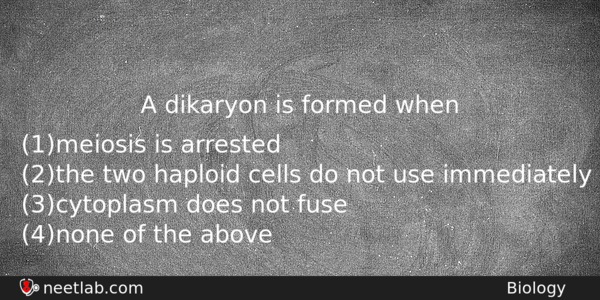
A dikaryon is formed when
Options
(a) meiosis is arrested
(b) the two haploid cells do not fuse immediately
(c) cytoplasm does not fuse
(d) none of the above
Correct Answer:
the two haploid cells do not fuse immediately
Explanation:
The dikaryon is a specialised form of heterokaryon in which each cell has two haploid nuclei, one from each parent of the cross.
Related Questions: - Which one of the following is not used in organic farming?
- Fermentation is anaerobic production of
- Passage of materials to and from the cells is carried out by and active transport
- The first movements of the foetus and appearance of hair on its head are usually
- Cladodes are found in
Question Type: Memory
(964)
Difficulty Level: Easy
(1008)
Topics: Diversity In Living World
(339)
Subject: Biology
(4253)
Important MCQs Based on Medical Entrance Examinations To Improve Your NEET Score
- Which one of the following is not used in organic farming?
- Fermentation is anaerobic production of
- Passage of materials to and from the cells is carried out by and active transport
- The first movements of the foetus and appearance of hair on its head are usually
- Cladodes are found in
Question Type: Memory (964)
Difficulty Level: Easy (1008)
Topics: Diversity In Living World (339)
Subject: Biology (4253)
Important MCQs Based on Medical Entrance Examinations To Improve Your NEET Score
18000+ students are using NEETLab to improve their score. What about you?
Solve Previous Year MCQs, Mock Tests, Topicwise Practice Tests, Identify Weak Topics, Formula Flash cards and much more is available in NEETLab Android App to improve your NEET score.

Share this page with your friends
Leave a Reply