| ⇦ | 
| ⇨ |
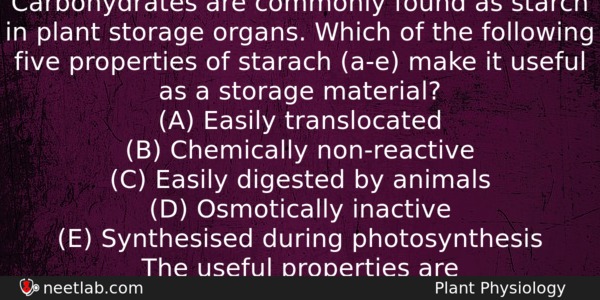
Carbohydrates are commonly found as starch in plant storage organs. Which of the following five properties of starach (a-e) make it useful as a storage material?
(A) Easily translocated
(B) Chemically non-reactive
(C) Easily digested by animals
(D) Osmotically inactive
(E) Synthesised during photosynthesis
The useful properties are
Options
(a) (B) and (C)
(b) (B) and (D)
(c) (A), (C) and (E)
(d) (A) and (E)
Correct Answer:
(B) and (D)
Explanation:
Carbohydrates are commonly found as starch in plant storage organs. It is chemically non-reactive and osmotically inactive polysaccharides of much greater molecules weight. Carbohydrates performs a vital role in living organisms. Starch and other polysaccharides serve as energy storage in plants, particularly in seeds, tubers, etc. which provide a major energy source for animals, including humans.
Related Questions: - Brown heart disease in cauliflower is due to the deficiency of
- Which of the following is wrong about Chara?
- How many pyrrole rings are there in porphyrin
- Conifers differ from grasses in the
- Tracheids differ from other tracheary element in
Topics: Plant Physiology
(28)
Subject: Biology
(4253)
Important MCQs Based on Medical Entrance Examinations To Improve Your NEET Score
- Brown heart disease in cauliflower is due to the deficiency of
- Which of the following is wrong about Chara?
- How many pyrrole rings are there in porphyrin
- Conifers differ from grasses in the
- Tracheids differ from other tracheary element in
Topics: Plant Physiology (28)
Subject: Biology (4253)
Important MCQs Based on Medical Entrance Examinations To Improve Your NEET Score
18000+ students are using NEETLab to improve their score. What about you?
Solve Previous Year MCQs, Mock Tests, Topicwise Practice Tests, Identify Weak Topics, Formula Flash cards and much more is available in NEETLab Android App to improve your NEET score.

Share this page with your friends
Leave a Reply