| ⇦ | 
| ⇨ |
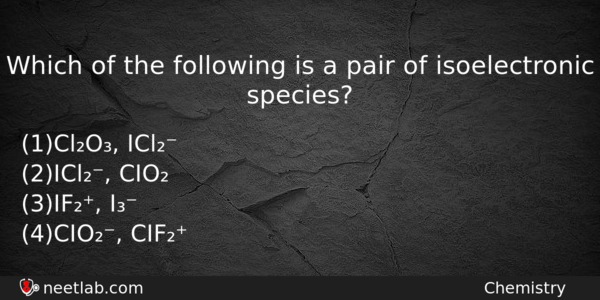
Which of the following is a pair of isoelectronic species?
Options
(a) Cl₂O₃, ICl₂⁻
(b) ICl₂⁻, CIO₂
(c) IF₂⁺, I₃⁻
(d) CIO₂⁻, CIF₂⁺
Correct Answer:
CIO₂⁻, CIF₂⁺
Explanation:
Number of electrons in CIO₂⁻ = 17+ 16+ 1 = 34 electrons.
Number of electrons in CIF₂⁺ = 17+ 18- 1 = 34 electrons.
Hence, CIO₂⁻ and CIF₂⁺ are isoelectronic species.
Related Questions: - Two miscible liquids can be separated by
- The most efficient agent for the absorption of SO₃ is
- The pair of species that has the same bond order in the following is:
- Alkyl halides can be converted into alcohol in a single step reaction.
- Reaction of HBr with propene in the presence of peroxide gives
Question Type: Memory
(964)
Difficulty Level: Easy
(1008)
Topics: Structure of Atom
(90)
Subject: Chemistry
(2512)
Important MCQs Based on Medical Entrance Examinations To Improve Your NEET Score
- Two miscible liquids can be separated by
- The most efficient agent for the absorption of SO₃ is
- The pair of species that has the same bond order in the following is:
- Alkyl halides can be converted into alcohol in a single step reaction.
- Reaction of HBr with propene in the presence of peroxide gives
Question Type: Memory (964)
Difficulty Level: Easy (1008)
Topics: Structure of Atom (90)
Subject: Chemistry (2512)
Important MCQs Based on Medical Entrance Examinations To Improve Your NEET Score
18000+ students are using NEETLab to improve their score. What about you?
Solve Previous Year MCQs, Mock Tests, Topicwise Practice Tests, Identify Weak Topics, Formula Flash cards and much more is available in NEETLab Android App to improve your NEET score.

Share this page with your friends
Leave a Reply