| ⇦ | 
| ⇨ |
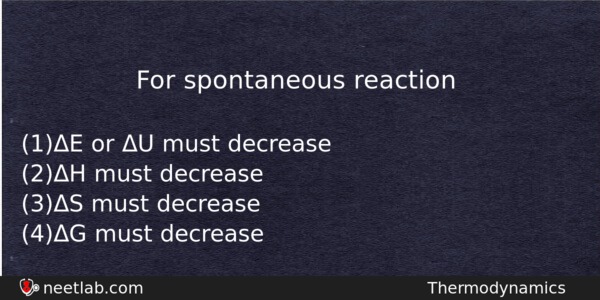
For spontaneous reaction
Options
(a) ΔE or ΔU must decrease
(b) ΔH must decrease
(c) ΔS must decrease
(d) ΔG must decrease
Correct Answer:
ΔG must decrease
Explanation:
For spontaneous reaction, ΔG = -ve, ΔG = ΔH – TΔS.
Related Questions: - Which has the maximum number of molecules among the following
- Cellulose is polymer of
- 12 g of an alkaline earth metal gives 14.8 g of its nitride .Atomic weight of the
- The wavelength of the radiation emitted when an electron drops from 3rd orbit
- An equation is given as:SnO₂ + C → Sn + CO.Its balanced form will involve
Topics: Thermodynamics
(179)
Subject: Chemistry
(2512)
Important MCQs Based on Medical Entrance Examinations To Improve Your NEET Score
- Which has the maximum number of molecules among the following
- Cellulose is polymer of
- 12 g of an alkaline earth metal gives 14.8 g of its nitride .Atomic weight of the
- The wavelength of the radiation emitted when an electron drops from 3rd orbit
- An equation is given as:SnO₂ + C → Sn + CO.Its balanced form will involve
Topics: Thermodynamics (179)
Subject: Chemistry (2512)
Important MCQs Based on Medical Entrance Examinations To Improve Your NEET Score
18000+ students are using NEETLab to improve their score. What about you?
Solve Previous Year MCQs, Mock Tests, Topicwise Practice Tests, Identify Weak Topics, Formula Flash cards and much more is available in NEETLab Android App to improve your NEET score.

Share this page with your friends
Leave a Reply