| ⇦ | 
| ⇨ |
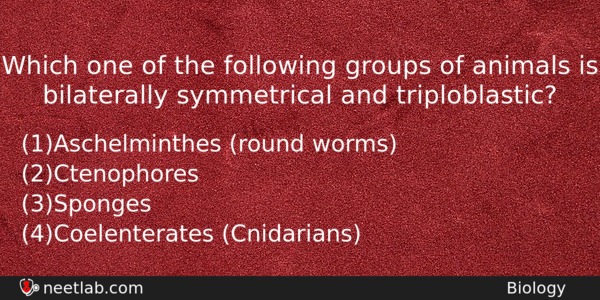
Which one of the following groups of animals is bilaterally symmetrical and triploblastic?
Options
(a) Aschelminthes (round worms)
(b) Ctenophores
(c) Sponges
(d) Coelenterates (Cnidarians)
Correct Answer:
Aschelminthes (round worms)
Explanation:
Aschelminthes is bilaterally symmetrical and triploblastic. These are mostly aquatic, free living or parasitic. Their body is three layered which is ectoderm, mesoderm and endoderm.
Related Questions: - Which of the following is a drought breed of Indian cattle?
- Human ears perform sensory functionsThese
- Which of the following is correct about heterospory
- Which of the following vitamins can’t be deposited inside the body?
- Acetyl CoA is produced from pyruvate by
Question Type: Memory
(964)
Difficulty Level: Easy
(1008)
Topics: Plant and Animal Kingdom
(295)
Subject: Biology
(4253)
Important MCQs Based on Medical Entrance Examinations To Improve Your NEET Score
- Which of the following is a drought breed of Indian cattle?
- Human ears perform sensory functionsThese
- Which of the following is correct about heterospory
- Which of the following vitamins can’t be deposited inside the body?
- Acetyl CoA is produced from pyruvate by
Question Type: Memory (964)
Difficulty Level: Easy (1008)
Topics: Plant and Animal Kingdom (295)
Subject: Biology (4253)
Important MCQs Based on Medical Entrance Examinations To Improve Your NEET Score
18000+ students are using NEETLab to improve their score. What about you?
Solve Previous Year MCQs, Mock Tests, Topicwise Practice Tests, Identify Weak Topics, Formula Flash cards and much more is available in NEETLab Android App to improve your NEET score.

Share this page with your friends
Leave a Reply