| ⇦ | 
| ⇨ |
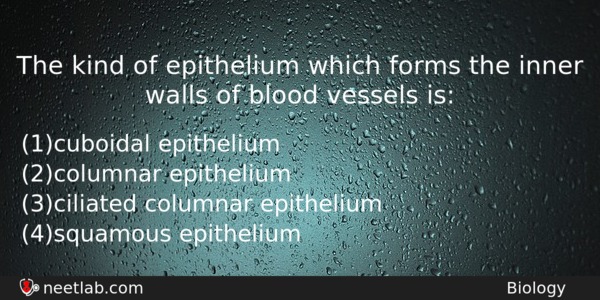
The kind of epithelium which forms the inner walls of blood vessels is:
Options
(a) cuboidal epithelium
(b) columnar epithelium
(c) ciliated columnar epithelium
(d) squamous epithelium
Correct Answer:
squamous epithelium
Explanation:
Squamous epithelium is formed of thin discoidal and polygonal cells that fit like tiles in a floor, so is also called pavement epithelium. It is found in the walls of blood vessels, in the alveoli of lung for exchange of gas, and in Bowman’s capsule of nephron for ultra filtration
Related Questions: - Autonomic genome system is present in
- Bundles of striated muscle fibres called fasciculi are enclosed by a sheath called
- True nucleus is absent in :
- The release of pancreatic juice from the pancreas in a mammal is stimulated by
- After fast running man has fast heart beat slow pulse and shallow breathing
Question Type: Memory
(964)
Difficulty Level: Easy
(1008)
Topics: Structural Organisation In Animals
(175)
Subject: Biology
(4253)
Important MCQs Based on Medical Entrance Examinations To Improve Your NEET Score
- Autonomic genome system is present in
- Bundles of striated muscle fibres called fasciculi are enclosed by a sheath called
- True nucleus is absent in :
- The release of pancreatic juice from the pancreas in a mammal is stimulated by
- After fast running man has fast heart beat slow pulse and shallow breathing
Question Type: Memory (964)
Difficulty Level: Easy (1008)
Topics: Structural Organisation In Animals (175)
Subject: Biology (4253)
Important MCQs Based on Medical Entrance Examinations To Improve Your NEET Score
18000+ students are using NEETLab to improve their score. What about you?
Solve Previous Year MCQs, Mock Tests, Topicwise Practice Tests, Identify Weak Topics, Formula Flash cards and much more is available in NEETLab Android App to improve your NEET score.

Share this page with your friends
Leave a Reply