| ⇦ | 
| ⇨ |
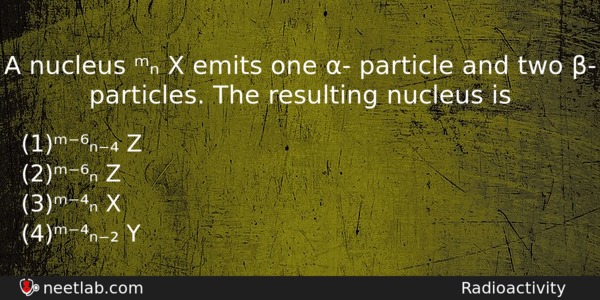
A nucleus ᵐₙ X emits one α- particle and two β- particles. The resulting nucleus is
Options
(a) ᵐ⁻⁶ₙ₋₄ Z
(b) ᵐ⁻⁶ₙ Z
(c) ᵐ⁻⁴ₙ X
(d) ᵐ⁻⁴ₙ₋₂ Y
Correct Answer:
ᵐ⁻⁴ₙ X
Explanation:
When ᵐₙ X emits one α- particle then its atomic mass decreases by 4 units and atomic number4 by 2. Therefore, the new nucleus becomes ᵐ⁻⁴ₙ₋₂ Y. But as it emits two β⁻ particles, its atomic number incre4ases by 2. Thus the resulting nucleus is ᵐ⁻⁴ₙ X.
Related Questions: - A wire of length L metre carrying a current I ampere is bent in the form
- In communication with help of antenna if height is doubled then the range
- A p-n photodiode is fabricated from a semiconductor with a band gap of 2.5 eV.
- A piece of iron is heated in a flame. It first comes dull red then becomes reddish
- The phase difference between two points seperated by 0.8 m in a wave of frequency
Topics: Radioactivity
(83)
Subject: Physics
(2479)
Important MCQs Based on Medical Entrance Examinations To Improve Your NEET Score
- A wire of length L metre carrying a current I ampere is bent in the form
- In communication with help of antenna if height is doubled then the range
- A p-n photodiode is fabricated from a semiconductor with a band gap of 2.5 eV.
- A piece of iron is heated in a flame. It first comes dull red then becomes reddish
- The phase difference between two points seperated by 0.8 m in a wave of frequency
Topics: Radioactivity (83)
Subject: Physics (2479)
Important MCQs Based on Medical Entrance Examinations To Improve Your NEET Score
18000+ students are using NEETLab to improve their score. What about you?
Solve Previous Year MCQs, Mock Tests, Topicwise Practice Tests, Identify Weak Topics, Formula Flash cards and much more is available in NEETLab Android App to improve your NEET score.

Share this page with your friends
Leave a Reply