| ⇦ | 
| ⇨ |
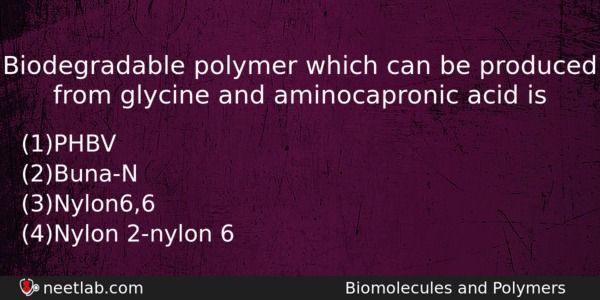
Biodegradable polymer which can be produced from glycine and aminocapronic acid is
Options
(a) PHBV
(b) Buna-N
(c) Nylon6,6
(d) Nylon 2-nylon 6
Correct Answer:
Nylon 2-nylon 6
Explanation:
H₂N–CH₂–COOH (Glycine)+H₂N–(CH₂)₅–COOH (Aminocapric acid) → (HN–CH₂–CO–NH–(CH₂)₅–CO–) (Nylone-2-nylone -6)
.
Related Questions: - The pair of compounds that can exist together is
- Which of the following has lowest pH value
- If 0.1 M of a weak acid is taken, and its percentage of degree of ionization
- When 2-bromobutane reacts with alcoholic KOH, the reaction is called
- The turbidity of a polymer solution measures the
Topics: Biomolecules and Polymers
(88)
Subject: Chemistry
(2512)
Important MCQs Based on Medical Entrance Examinations To Improve Your NEET Score
- The pair of compounds that can exist together is
- Which of the following has lowest pH value
- If 0.1 M of a weak acid is taken, and its percentage of degree of ionization
- When 2-bromobutane reacts with alcoholic KOH, the reaction is called
- The turbidity of a polymer solution measures the
Topics: Biomolecules and Polymers (88)
Subject: Chemistry (2512)
Important MCQs Based on Medical Entrance Examinations To Improve Your NEET Score
18000+ students are using NEETLab to improve their score. What about you?
Solve Previous Year MCQs, Mock Tests, Topicwise Practice Tests, Identify Weak Topics, Formula Flash cards and much more is available in NEETLab Android App to improve your NEET score.

Share this page with your friends
Leave a Reply